

How Data is Intrinsic to Winning the Fight against Cybercrime
An estimated 4.66 billion people around the world currently use the internet, a number that has tripled in the past 12 years as connectivity has become more accessible, and that will continue to increase. Underlaying this phenomenal growth is an equivalent risk. Cybercriminals steal an estimated $600 billion per year from governments, companies and individuals, while the overall loss of company revenues over the course of five years, from 2019 to 2023, will reach $5.2 trillion.[1]
The Australian government recently shared this infographic illustrating the cost of cybercrime just in our market. It is shocking to see how 50% of the costs are caused by web-based attacks and insiders, and 53% of the cost is on detection and recovery. If there was a way to proactively scan for security gaps, or better yet proactively stem the possibility of a gap, we could save hundreds and thousands in at-risk business revenues with a few steps.
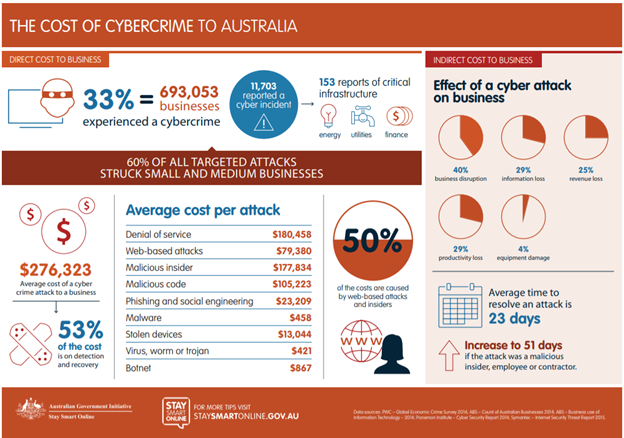
[2] Infographic on The Cost of Cybercrime to Australia
“When data impacts dollars, reputations and lives, there cannot be mistakes.”
Human error continues to be the main cause of data breaches in Australia. In fact, the Office of the Australian Information Commissioner (OAIC) received 539 data breach notifications from July to December 2020, an increase of 5% on the previous six months. Nearly two in five breaches were attributed to human error. As Australian employees fail to recognise emerging cyber threats appearing under remote working conditions, there must be more considerations on how we can tighten processes and governance to mitigate such risks.
Knowing Your Data is Your Road to Victory
Firstly, what is Data Lineage? Think of Data Lineage almost like a genealogy record. It tells you where the data is from, how it got to where it is today, and what changes (or transformations) it has undergone before getting to where/what it is now. Tracking how data moves from point-to-point only provides us with a limited map from an IT perspective. It is critical to capture the traceability of data back to its business requirements, which will give us the context and value of how this data is applied.
So how does knowing Data Lineage and having a Data Lineage Strategy help us win the fight against cybercrime?
There are several real-world applications on how Data Lineage can strengthen your overall data management strategy, with an approach to proactively reduce any uncertainties and create an accountable framework to how data flows within your organization, your business partners and customers.
Here are my top three to win the fight against cybercrime.
#1 Changing Business Requirements
There will be times where your users want changes to their reports and dashboards, resulting in changes to the metadata. Examples could be changes in the name of an attribute or modifications to the attribute’s data type.
It is imperative to identify the impact of this attribute’s changes throughout the application landscape using Data Lineage. It helps answer questions like what data sources feed the most significant number of downstream sources before making any changes. Where there is an aligned approach, it removes doubt.
#2 Audit and Supervisor Requirements
No question that there is a pressing need for Risk Management and Finance functions to explain how figures and critical metrics are derived. This requirement requires tracing back a full chain of transformed or manipulated data elements using Data Lineage.
Data Lineage provides visibility into the data pipelines and information flows that can then be audited.
#3 Data Quality
Upholding high quality data should be non-negotiable. Data Lineage plays a critical role in performing root cause analysis when identifying data quality issues. Most often, the data quality issues determined through Data Lineage is diagnosed at the source. It is much more efficient to fix source issues instead of fixing them downstream or at the reporting layer.
Using a Data Lineage mapping, the steward can trace back through the information flow, examine the standardizations and transformations applied to the data, validate that transformations were correctly performed, or identify one (or more) performed incorrectly, resulting in the data flaw.
Getting started on how Data Lineage can help your organization should not be an uphill task. When you have the right resources on your team, you can accelerate towards a stronger data strategy at a phenomenal pace as well.
Ascention wishes to impart skills and knowledge. The team at Ascention is always willing to share our experiences to assist your team’s progress – simply contact us to start an informal, no-obligation discussion.
Ascention Contact:
Alan Abraham, Chief Sales Officer
M: +61 419 485 420
Please see previous topics:
[1] http://www3.weforum.org/docs/WEF_Partnership_against_Cybercrime_report_2020.pdf
[2] https://www.communications.gov.au/sites/default/files/Cost%20of%20cybercrime_INFOGRAPHIC_WEB_published_08102015.pdf
